
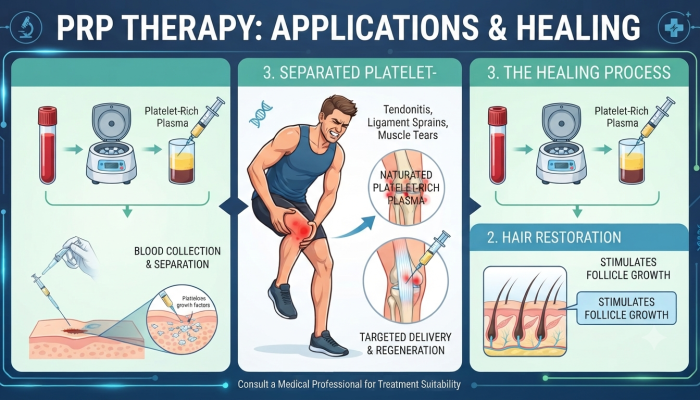
PRP for Sports Injuries: Accelerating Recovery Through Natural Healing
Sports injuries affect both professional athletes and individuals who participate in recreational physical activities. Muscle strains, tendon injuries, ligament injuries, and repetitive overuse conditions can significantly prolong recovery time and limit performance and quality of life.
Platelet-Rich Plasma (PRP) therapy has gained increasing attention in regenerative medicine because it utilizes the body’s own biological mechanisms to support tissue repair and healing.
Unlike anti-inflammatory medications, which primarily focus on reducing pain and inflammation, PRP aims to create a biological environment that may promote tissue regeneration and recovery.
However, it is important to understand that PRP does not replace physical therapy or a structured rehabilitation program. Current scientific evidence suggests that PRP tends to provide better outcomes when incorporated into a comprehensive treatment plan that includes therapeutic exercise, strength training, mobility work, and correction of biomechanical factors contributing to injury.
What Sports Injuries May Benefit From PRP Therapy?
Research has evaluated PRP therapy for several common sports-related injuries, including:
- Patellar tendinopathy (“jumper’s knee”)
- Achilles tendinopathy
- Lateral epicondylitis (“tennis elbow”)
- Rotator cuff injuries
- Selected muscle tears
- Chronic plantar fasciitis
The most favorable outcomes are generally observed in chronic injuries, where tissues may have developed degenerative changes and reduced natural healing capacity.
For acute injuries, research continues to evolve, and there is still no universal agreement regarding all indications.
PRP for Tendon Injuries: One of the Most Scientifically Supported Applications
Tendons have relatively limited blood supply compared with other tissues, which helps explain why many tendon injuries can take months to heal.
When a tendon experiences repeated microscopic damage, the normal repair process may become insufficient, leading to persistent pain and reduced function.
PRP therapy aims to deliver a concentrated amount of platelets and growth factors directly into the injured area to support the body’s healing response.
What Does the Research Show?
Systematic reviews and clinical studies suggest that PRP may provide meaningful improvements in certain chronic tendinopathies, particularly when traditional conservative treatments have not produced adequate improvement.
Conditions showing some of the most promising results include:
PRP for Tennis Elbow (Lateral Epicondylitis)
Lateral epicondylitis is considered one of the tendon conditions with the strongest evidence supporting PRP use.
Several studies have found that PRP may provide better long-term outcomes compared with corticosteroid injections.
While corticosteroids may provide faster short-term pain relief, research suggests they may be associated with higher recurrence rates over time.
PRP appears to work more gradually by supporting tissue healing rather than only masking symptoms.
PRP for Patellar Tendinopathy (“Jumper’s Knee”)
Patellar tendinopathy is common among runners, jump athletes, and individuals involved in repetitive knee-loading activities.
PRP may improve pain and function when combined with a structured rehabilitation program, especially exercises designed to strengthen the tendon and restore proper biomechanics.
PRP for Achilles Tendinopathy
The results for Achilles tendon injuries are more variable.
Some studies demonstrate potential benefits, while others show limited differences compared with conventional treatments.
Because of these mixed findings, treatment decisions should be individualized based on the patient’s symptoms, injury characteristics, and overall health.
PRP for Plantar Fasciitis
Plantar fasciitis is one of the most common causes of chronic heel pain.
Many patients improve with conservative treatments such as:
- Stretching exercises
- Physical therapy
- Orthotic support
- Activity modification
However, some individuals develop chronic plantar fasciitis that persists for many months despite appropriate treatment.
In these cases, several systematic reviews and meta-analyses suggest that PRP may provide better medium- and long-term outcomes compared with corticosteroid injections, particularly regarding pain reduction and functional improvement.
PRP for Hair Loss: What Does the Science Really Show?
Progressive hair loss affects millions of men and women worldwide.
Although multiple treatments are available, Platelet-Rich Plasma therapy has become one of the most studied options in regenerative medicine for hair restoration.
Current scientific evidence suggests that PRP may improve:
- Hair density
- Hair thickness
- Hair growth rate
- Reduction of excessive shedding
However, there is an important factor that many patients do not realize.
The Timing of Treatment Influences PRP Results
One of the most consistent findings in scientific literature is that PRP tends to work best during the early and moderate stages of androgenetic alopecia.
Why? Because PRP does not create new hair follicles.
Instead, its purpose is to stimulate follicles that are still alive but have begun to weaken and produce thinner hair.
What Happens During Hair Loss?
Androgenetic alopecia progresses through a gradual process known as follicular miniaturization.
During this process:
- Hair becomes progressively thinner.
- The active growth phase becomes shorter.
- Follicles produce smaller and weaker hairs.
- In advanced stages, some follicles may lose their ability to produce visible hair.
As long as follicles remain viable, regenerative treatments such as PRP may help stimulate their activity.
However, when a follicle has completely lost its functional capacity, PRP cannot recreate it.
For this reason, starting treatment earlier is generally associated with better chances of improvement.
Who Is More Likely to Benefit From PRP for Hair Loss?
Scientific literature suggests that patients with the highest likelihood of response often have:
 Mild hair loss.
Moderate hair loss.
Existing hair that has become thinner.
Viable hair follicles.
Patients with advanced baldness generally experience more limited responses.
In these situations, physicians may recommend other options, including hair transplantation or combined treatment approaches.
Can PRP Be Combined With Other Hair Restoration Treatments?
Yes. Many specialists believe that combination therapy may provide better outcomes than using a single treatment alone.
Depending on the patient’s diagnosis and medical history, PRP may be incorporated into a personalized treatment plan that includes:
- Topical minoxidil
- Oral minoxidil when medically appropriate
- Finasteride or dutasteride in selected patients
- Microneedling
- Nutritional supplementation when a documented deficiency exists
- Hair transplantation as a complementary option
Combination treatments should always be personalized and supervised by a qualified healthcare professional.
Does PRP Work for Every Type of Hair Loss?
No.The first step is identifying the underlying cause of hair loss.
Current evidence is strongest for androgenetic alopecia, also known as pattern hair loss.
For other conditions, such as certain autoimmune or scarring alopecias, evidence remains limited, and treatment decisions must be made on an individual basis.
Personalized Treatment Provides Better Results
One of the most common misconceptions is that PRP works the same way for everyone.
The reality is that multiple factors influence treatment response, including:
- Age
- Overall health status
- Quality of the PRP preparation
- Platelet concentration
- Injection technique
- Correct diagnosis
- Stage of disease
- Compliance with complementary treatments
For this reason, a comprehensive medical evaluation remains the most important step before beginning any regenerative therapy
The Importance of Evidence-Based PRP Treatment
PRP therapy represents an exciting advancement in regenerative medicine, but it should be approached with realistic expectations.
The best candidates are those who receive an accurate diagnosis, understand the potential benefits and limitations, and follow a personalized treatment strategy.
A qualified medical evaluation helps determine whether PRP is an appropriate option and whether combining it with other therapies may improve outcomes.
If you need a consultation with Dr. Antonio González Sotomayor, please schedule an appointment by calling 939-222-2554.
We are located at Galerías Ponceñas, Union 83, in Ponce, Puerto Rico.
Our office hours are Monday through Thursday from 8:00 AM to 2:00 PM and Saturdays from 10:00 AM to 2:00 PM.
References and Evidence Sources
This article was developed based on peer-reviewed scientific literature and current evidence regarding Platelet-Rich Plasma (PRP) therapy, regenerative medicine, sports medicine, and hair restoration. Medical information should be interpreted in the context of an individual patient evaluation by a qualified healthcare professional.
- Foster TE, Puskas BL, Mandelbaum BR, Gerhardt MB, Rodeo SA. Platelet-rich plasma: from basic science to clinical applications. The American Journal of Sports Medicine. 2009;37(11):2259-2272. doi:10.1177/0363546509349921
- Marx RE. Platelet-rich plasma: evidence to support its use. Journal of Oral and Maxillofacial Surgery. 2004;62(4):489-496. doi:10.1016/j.joms.2003.12.003
- Sánchez M, Fiz N, Azofra J, et al. A randomized clinical trial evaluating plasma rich in growth factors for chronic lateral epicondylitis. Arthroscopy. 2017;33(3):536-544.
- Mishra A, Pavelko T. Treatment of chronic elbow tendinosis with buffered platelet-rich plasma. The American Journal of Sports Medicine. 2006;34(11):1774-1778.
- Fitzpatrick J, Bulsara M, Zheng MH. The effectiveness of platelet-rich plasma in the treatment of tendinopathy: a meta-analysis of randomized controlled clinical trials. The American Journal of Sports Medicine. 2017;45(1):226-233. doi:10.1177/0363546516643716
- de Vos RJ, Weir A, van Schie HTM, et al. Platelet-rich plasma injection for chronic Achilles tendinopathy: a randomized controlled trial. JAMA. 2010;303(2):144-149. doi:10.1001/jama.2009.1986
- Dragoo JL, Wasterlain AS, Braun HJ, Nead KT. Platelet-rich plasma as a treatment for patellar tendinopathy: a double-blind randomized controlled trial. The American Journal of Sports Medicine. 2014;42(3):610-618.
- Ragab EM, Othman AM. Platelet rich plasma for treatment of chronic plantar fasciitis. Archives of Orthopaedic and Trauma Surgery. 2012;132:1065-1070.
- Dhurat R, Sukesh M. Principles and methods of preparation of platelet-rich plasma: a review and author’s perspective. Journal of Cutaneous and Aesthetic Surgery. 2014;7(4):189-197.
- Gupta AK, Carviel JL, MacLeod MA. Platelet-rich plasma therapy for androgenetic alopecia: a systematic review. Journal of Dermatological Treatment. 2017;28(8):1-8.
- Evans AG, Mwamba RN, Goh C. Platelet-rich plasma for androgenetic alopecia: a systematic review and meta-analysis. Journal of the American Academy of Dermatology. 2022.
- Alves R, Grimalt R. A review of platelet-rich plasma: history, biology, mechanism of action, and classification. Skin Appendage Disorders. 2018;4:18-24.
- Gentile P, Cole JP, Cole MA, et al. Evaluation of platelet-rich plasma and platelet-rich plasma-derived growth factors in hair growth. Dermatologic Surgery. 2017;43(6):794-801.
- Picard F, Hersant B, Bosc R, Meningaud JP. The growing evidence for the use of platelet-rich plasma in regenerative medicine. Journal of Plastic, Reconstructive & Aesthetic Surgery. 2015;68(4):489-496.
- Le ADK, Enweze L, DeBaun MR, Dragoo JL. Current clinical recommendations for use of platelet-rich plasma. Current Reviews in Musculoskeletal Medicine. 2018;11:624-634.
- Andia I, Abate M. Platelet-rich plasma: underlying biology and clinical correlates. Regenerative Medicine. 2013;8(5):645-658.
- Anitua E, Sánchez M, Orive G, Andía I. The potential impact of the preparation rich in growth factors (PRGF) in different medical fields. Biomaterials. 2007;28(31):4551-4560.
- American Academy of Orthopaedic Surgeons (AAOS). Clinical perspectives on platelet-rich plasma in orthopaedic conditions.
- American Academy of Dermatology (AAD). Guidance regarding platelet-rich plasma for hair loss.